After checking into our cruise and having our first fancy lunch on board, we met up with Myo again for an afternoon of Mandalay-area sightseeing. We stopped to take a short stroll on the campus of a university for monks,

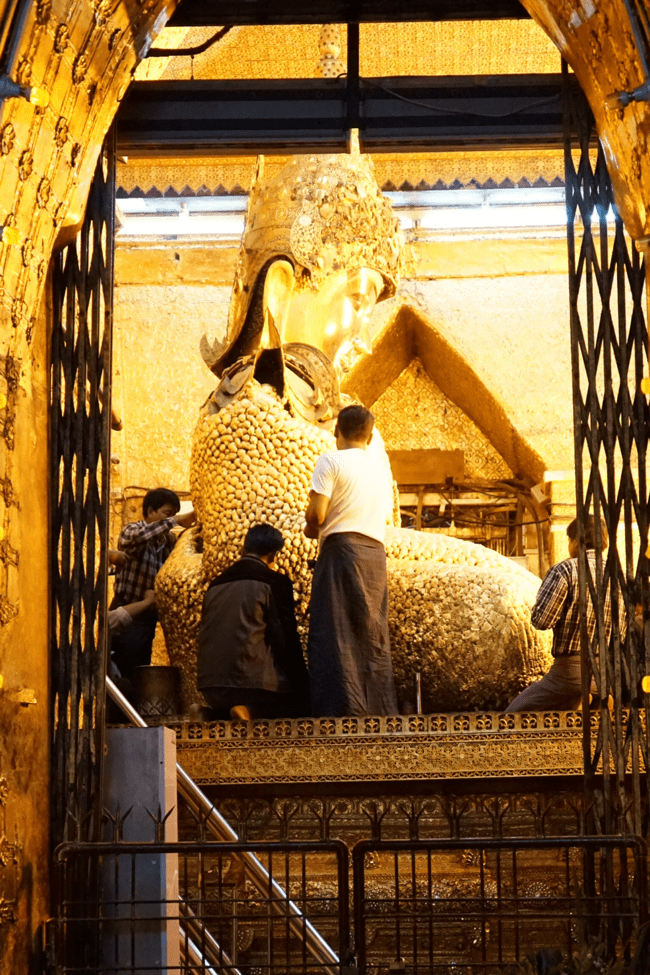
visited a Buddha that people add small bits of gold leaf onto to honor relatives and hope for good fortune (correction: men add bits of gold leaf, as women are forbidden to do so. A leftover Hindu tradition, as, according to Myo, Buddhism does not discriminate based on gender),
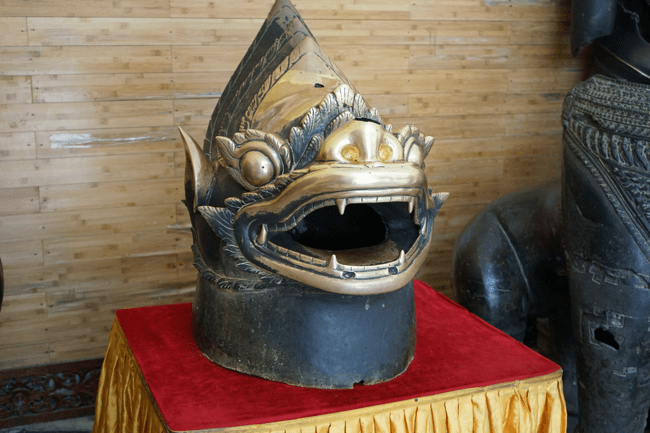
And rubbed the nose of an ancient bronze statue for good luck.
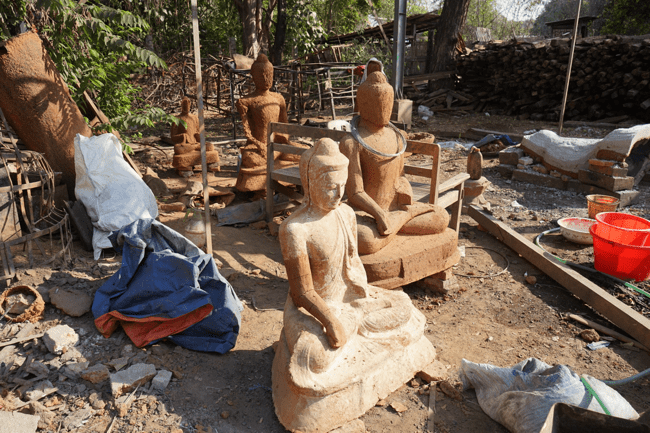
We then visited a workshop where bronze Buddha images are made entirely by hand (and are supposedly some of the finest of their kind in the world and can be found in temples and monasteries around the globe). These are examples of the mud and straw molds that are constructed from scratch every time a new image is made; between two layers of this lies a very detailed wax mold, which is what the heated bronze surrounds to create the final product.
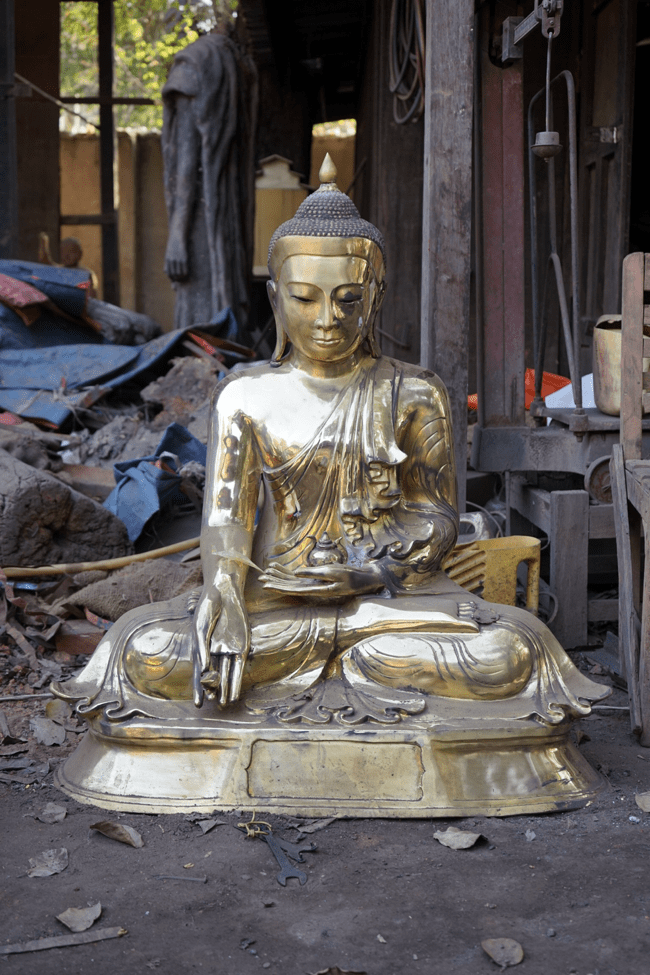
This isn’t a top notch example, but it gives you at least the flavor of the end result. They’re quite beautiful.
There’s also a street not far from here where a line of workshops create Buddha images out of marble, which is mined in Myanmar.

This is very dusty work.
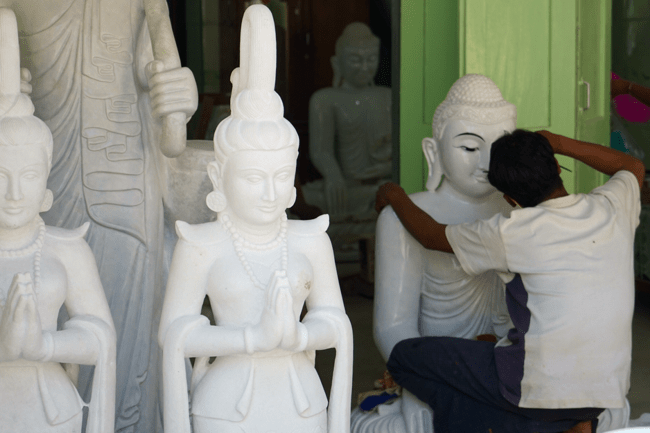
The faces are carved and painted last, and are modeled generally after the visage of the person who commissioned the image, or that of someone the purchaser wishes to honor.
Next we visited a silk weaving workshop, where 1-3 women create the most intricate designs, of course, all by hand.
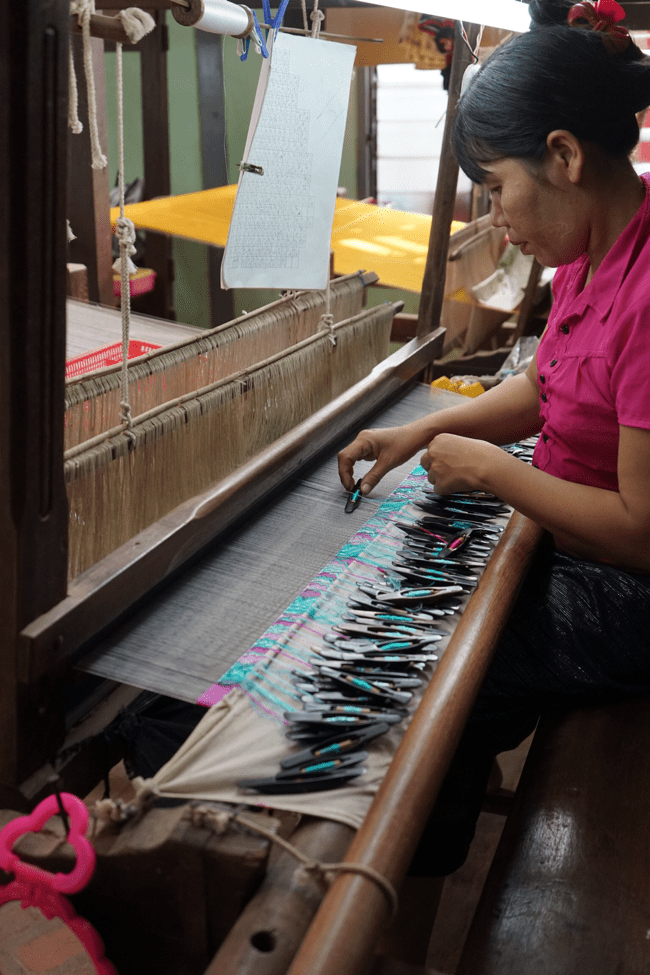
Look at the number of threads she is using! The paper at eye level is the pattern, so the work is all done by counting and memory. The pink thing in the lower left-hand corner is a hand mirror that one can use to look underneath her work, which is actually the front of the fabric. One woman working on an intricate pattern like this can complete about one inch of fabric per day, with a finished product taking about two months. The most expensive item in the shop next door is the same as a pattern commissioned by a general’s wife; for 2 meters of fabric the price is US$2,000. Most of the expensive fabtric made here is purchased by very wealthy women to be used in clothing. We were both in awe of what these women can do.
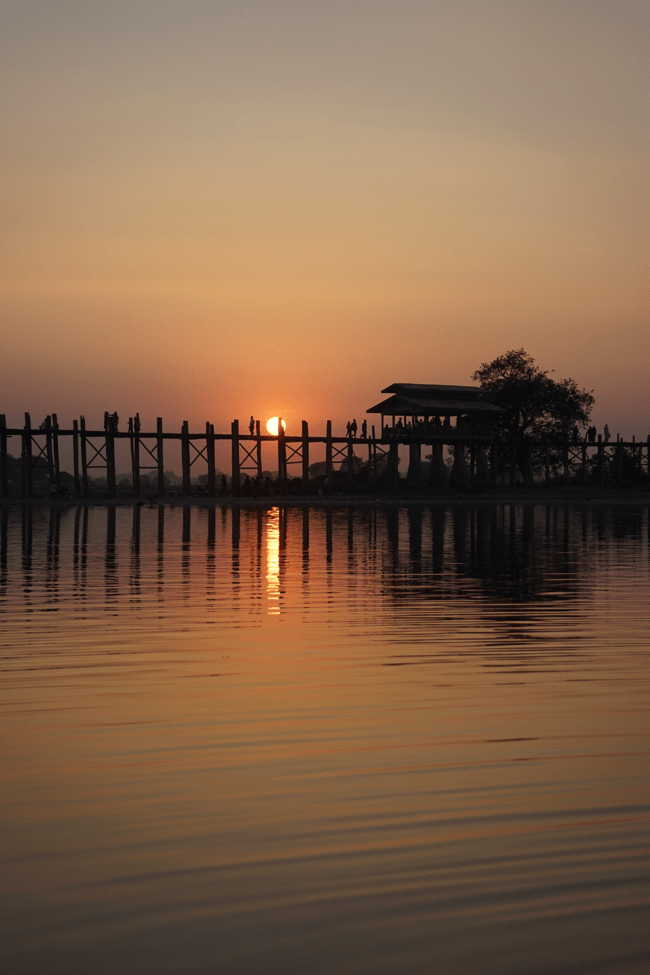
The day concluded with what was, up to this point, the most touristy attraction we’d done so far: sunset at U Bein’s Bridge. The world’s longest teak footbridge, it extends 1,300 yards across Taungthaman Lake, which at this time of year (dry) is pretty low, so the brige actually crosses a lot of seasonal farmer’s fields. We arrived at the parking lot a little on the early side, so elected to sit at one of the cafes for a soda and rest. This was where, for the very first time in Myanmar, we encountered begging. I’d so far marveled at the absense ot if here, as I get panhandled in San Francisco (and downtown San Rafael) on a daily basis. Seems to me that people here have to feel extraordinarily desperate to resort to straight-up asking for money in return for no work performed. Usually you’ll encounter people at least making an attempt to provide some kind of service in exchange for money: cleaining up a section of stairs at a pagoda (and asking for “donations for cleaning,”) or sweeping the sand off a stretch of road in the hopes that tour buses will open their windows and toss out some candy and a few kyats as they pass. The begging was upsetting; it breaks your heart to have a bent-over old woman stand beneath your cafe chair and repeat, “Money, money, money, money…” You feel rude for ingnoring her, but also know the perils of engaging, even with eye contact. For me it cast a dark pall on this particular experience.
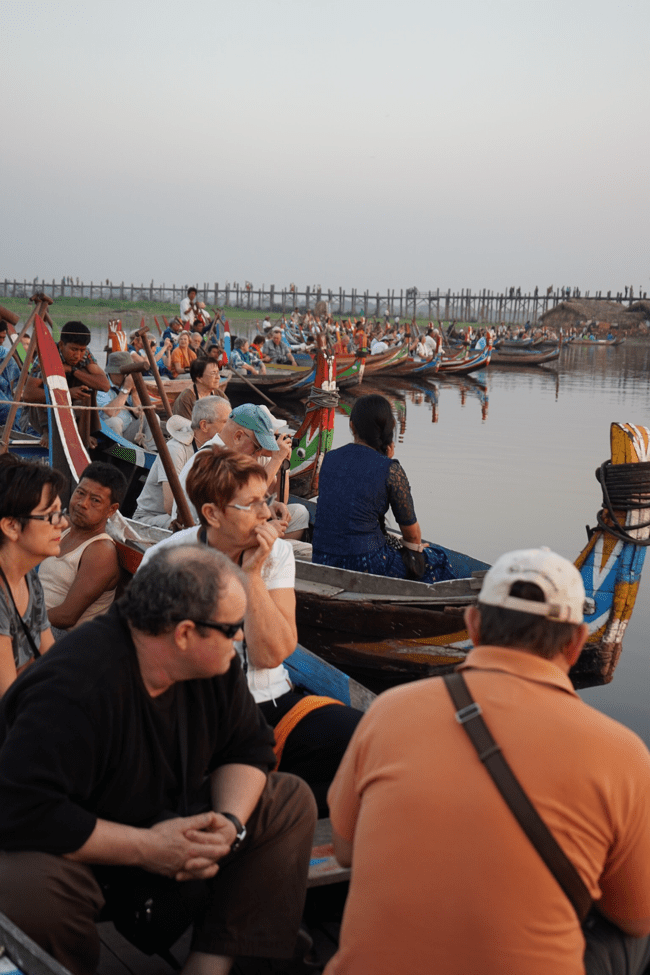
But we stuck it out and got on our rented boat to observe the bridge at sunset. I’m not a big sunset freak myself, but it’s a big tourist attraction here, so when in Rome…
We weren’t the only ones with this plan.
 A Month in Myanmar