For tourists who are “pagodad-out,” (which is understandable here) Mt. Popa near Bagan provides a little opportunity escape to a slightly cooler climate and explore a year-round fertile farming area. On the road to the mountain we stopped at a local palm juice factory, where from the liquid they make jaggery (candy that kind of looks like bulbous dog treats), toddy (alcohol that tates like… alcohol, though the shock was milder than that from straight vodka) and non-alcoholic juice (which tastes like dirt. Other than fish paste it’s the yuckiest thing I tasted in all of Myanmar). As a gesture of thanks for stopping by the propietors provide a plate of ingredients to make your own tea leaf salad before getting back in the car.
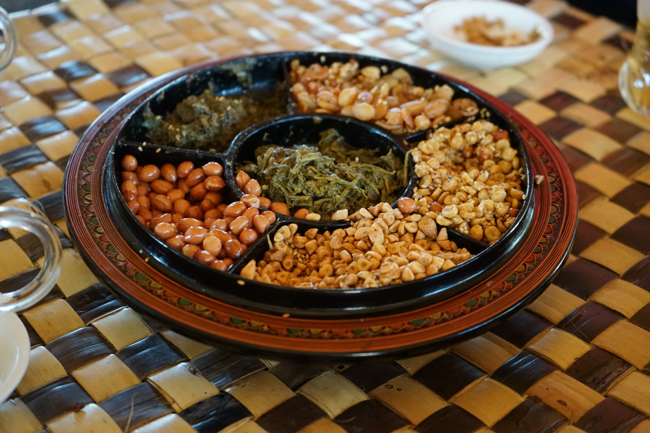
In the center are the tea leaves, the green stuff next to them is chili, then moving clockwise: two kinds of fried beans with sesame, dried garlic, and peanuts. Mixed together the combination is crunchy and delicious.
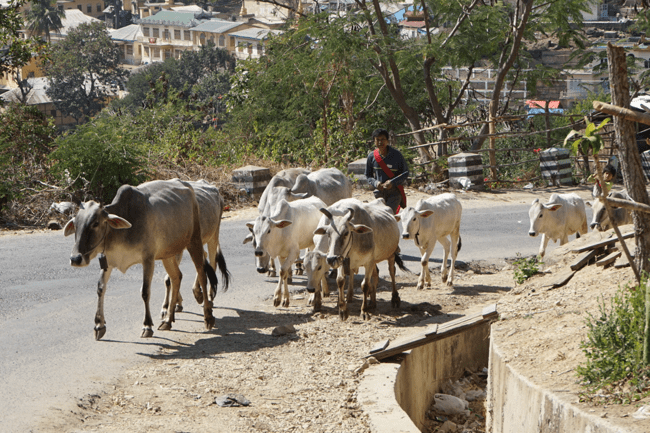
After a short walk through a local fruit market, where we also saw folks selling many kinds of plant seedlings, we arrived at the main town and major hub of activity. First we had to navigate through a small herd of cattle walking up the hill…
before we could park and see the first sight: a collection of statues representing the 37 nats that form a component of religion here.
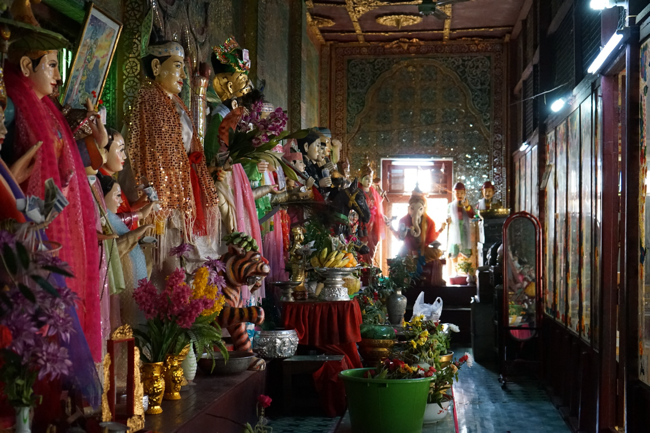
Some in human form, others in animal form, the local people believe that offerings to nats will bring them particular advantages: a good marrige, prosperous harvest, releif from illness, etc.
A brief pause here to discuss an aspect of tourism in Myanmar I haven’t really explored yet: the taking off of shoes. Entering most buildings of any kind (especially homes and offices) require you to remove your shoes; entering a pagoda requires you to be totally barefoot (no socks, which I just heard you can keep on in Thailand). If you are a germaphobe, I would not recommend a trip to Myanmar. In order to get the most out of temple visits you have to let go of your Western cleanliness and santitation expectations and get used to walking on dirty floors. Some spots are cleaner than others and there is no rhyme or reason as to why. The only time prior to the visit to Mt. Popa that I was grossed out was the day we had to step around a large vomit pile to get to a site. But the floor of this temple was, up to this point, the grimiest of all. But despite my discomfort, off the shoes went and I am glad I got over it to see this utterly bizarre collection of characters.
Exiting the nat shrine, Myo asked if we wanted to “go up” – how far up we weren’t sure – to the temple on the hill. This was a classic case of what you don’t know can’t hurt you, as if I had known in advance that the journey would include 777 steps, and that about a quarter of the way up you have to take off your shoes, and that the whole staircase and mountainside is crawling with monkeys, and that sometimes said mokeys poop on the very stairs you climb with your bare feet, I might have declined the invitation. But by the time all of this began to reveal itself to me, we were halfway up and committed.

I’m an animal-lover, and seeing monkeys “in the wild” was definitely cool. They’re cute, too – about a foot and a half high when sitting like this. But they are also pests, having been trained to beg for food by humans (one cheeky fellow even tried to pull my water bottle right out of my hands – and it was a struggle – he was strong!) and not having the decency to relieve themselves in private.
There were a number of shrines along the way, dedicated to certain nats or revered locals. When you reach the top is when you can really appreciate the climb you’ve just completed.
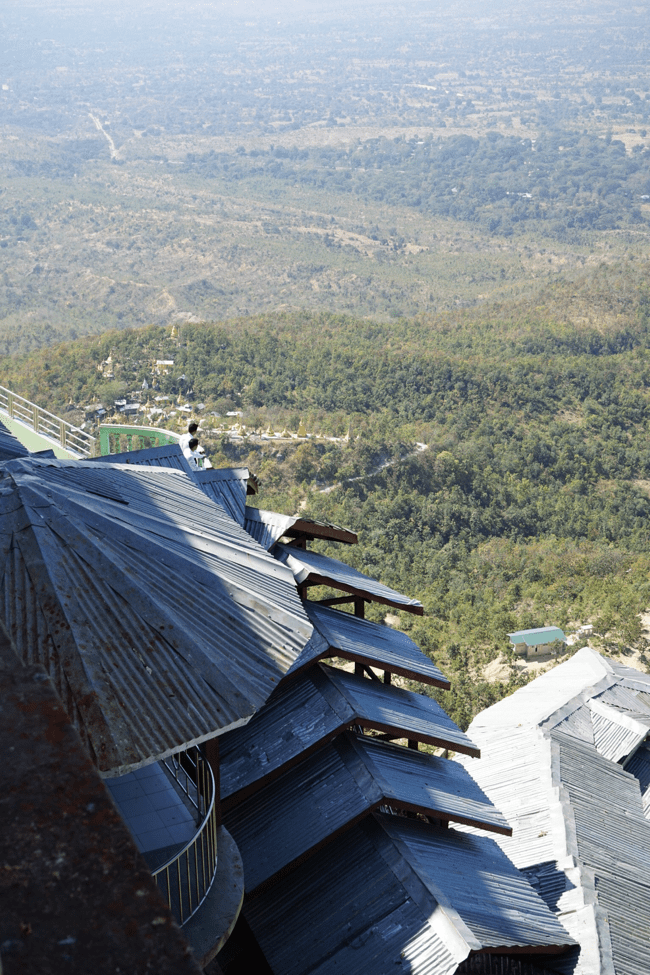
Not to mention push all concerns for structural safety right out of your head, as the only way to get down is to use the very same 777 stairs you used to climb up.
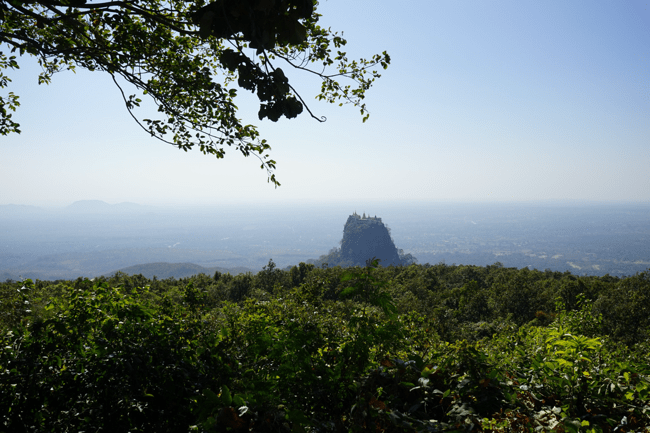
A view of the oucropping and temples on top from our lunch stop.
We then hopped back in the car for the 90-minute drive back to our Bagan hotel, where we elected to comclude our touring a little earlier than normal to give ourselves a chance to catch our breaths before returning to Yangon the next morning.
 A Month in Myanmar