For once our logistics did not call for domestic air travel, as we sailed down the Ayeyarwaddy River from Mandalay to Bagan aboard the Orient-Express cruise “Road to Mandalay.” The boat is luxurious by any standards, and given the somewhat limited availabilty of top-end accommodations in Myanmar, she feels especially swish here.
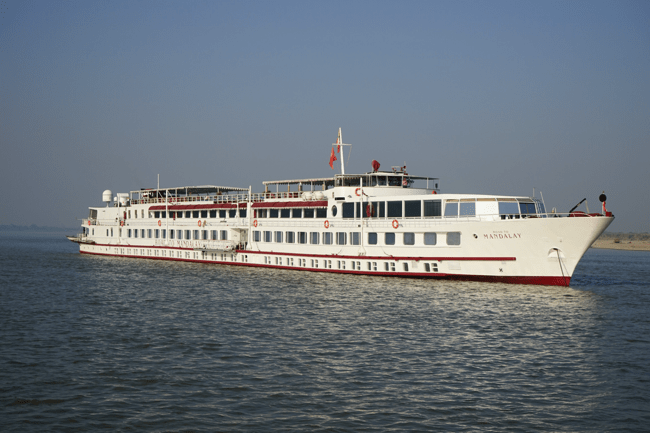
The 60-ish passengers (representing 14 nationalities) aboard our three-night trip were cared for by over 70 staff (where do they all sleep? was the first question that entered our minds), all but three of whom are Myanmar locals. While this is good news in the job-creation department (though who knows what they are paid and oh yes we were generous tippers just in case that’s what they live on), ever since my first trip to Mexico as a college freshman I’ve felt a little uncomfortable with such noticable language, ethnicity, and class gaps between tourist and employee. It’s worth saying that everyone working on this boat was exceedingly professional, competent, and kind. We were especially impressed by the restaurant wait staff, most of whom are hired to perform a litany of bizarre fancy dining rituals (the amouse bouche presentation, meat temperature requests, pre-dessert table crumb scraping, tasting a wine prior to accepting the selection…) they themselves had never before experienced.
Though passengers spend three nights on board, the actual cruise to Bagan takes about 8 hours and must, by local law, be conducted only in daylight. So apart from that day, the Road to Mandalay feels like a floating (docked) hotel. The sailing day is day 2, so our first day on board we remained docked in Mandalay until the next morning.
The day we checked in we were not required to be on board until 11am, so Myo squeezed in a morning trip to the neighboring town of Sagaing. Between 1364 and 1841 (right before the British showed up), Burmese kings routinely moved the empire’s capital to varying sites around Mandalay, as the belief was that no legitimate ruler would occupy his predecessor’s home. Sagaing, the capital around 1315, is now excusively a holy site, the hillsides dotted with inumerable stupas and monasteries, and a moratorium on residential and commercial establishments.
The highight of Sagaing is Umin Thounzeh, a crescent-shaped temple featuring a row of 45 Buddha images.
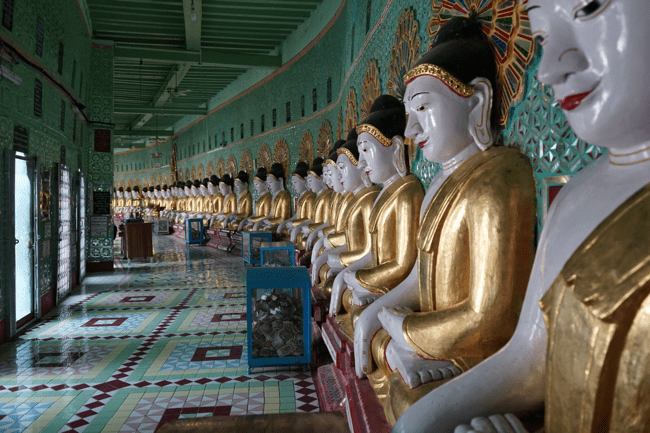
The building and maintenance of temples and stupas are done completely by donation, so at every site there are white marble signs indicating the family name and usually the amount of the donation. This temple was our first taste of international support, with English signs announcing support from Hawaii, San Jose, and a few European and Asian countries.
Next up: a jam-packed afternoon of holy sites, workshops, and a very long wooden footbridge.
 A Month in Myanmar